
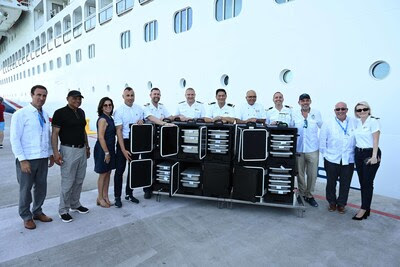

First Meal Donation in Honduras
There are moments in corporate sustainability that feel polished for PowerPoint decks. Then there are moments that actually land on a dinner table.
This week, Carnival Corporation marked a meaningful milestone in its global food waste reduction efforts by delivering its first-ever surplus meal donation in Latin America. The inaugural initiative took place in Roatán, Honduras, where 210 portions of prepared, unserved meals from the Carnival Cruise Line ship Carnival Jubilee were transferred ashore through Isla Tropicale and distributed to local organizations supporting communities in need.
For a company that moves millions of guests across oceans each year, the gesture may seem modest in size. Yet in a region where food insecurity remains an ongoing reality for many families, the symbolic weight matters. It transforms excess into access. It reframes waste as responsibility.
The donation is part of Carnival Corporation’s expanding “Less Left Over” strategy, a companywide initiative focused on reducing food waste while maintaining the large-scale dining operations expected aboard modern cruise ships. Since launching the program in 2017, Carnival has redirected more than 320,000 meal portions across 18 port destinations globally.
Now, Latin America officially joins that map.
Vicky Rey, vice president of government affairs for Latin America at Carnival Corporation, described the effort as a collaborative breakthrough requiring coordination between government leaders, local municipalities, and shipboard operations teams.
“Expanding our surplus meal donation program to Latin America is an important step in our Less Left Over strategy and an example of how collaboration can turn surplus into support for communities,” Rey said.
That collaboration appears to have moved quickly. Local officials in Roatán worked alongside Carnival representatives to establish procedures allowing prepared meals to move safely from ship to shore while meeting food safety standards.
Roatán Mayor Ron McNab emphasized the broader community impact, noting that the donated meals can now support schools, hospitals, and local organizations throughout the island community.
In many ways, the initiative also reflects a growing shift happening across the travel industry itself. Sustainability conversations are no longer confined to reusable straws and recycled towels. Increasingly, travelers and governments alike are asking major hospitality brands tougher questions about operational waste, community investment, and long-term accountability.
Cruise companies, perhaps more than anyone, sit at the center of that scrutiny.
Carnival’s answer has been scale paired with systems. According to the company, its Less Left Over strategy has already reduced per-person food waste by 47% since 2019 while avoiding more than $250 million in surplus food costs. The company says it remains on track toward its goal of cutting food waste by 50% by 2030.
That is not just environmental math. It is economic math too.
Meanwhile, Roatán remains one of Carnival Corporation’s most significant regional investments. Through Isla Tropicale, the company says it has invested approximately $93 million into the destination since 2009. The port has welcomed nearly 9 million visitors and generated an estimated $750 million in economic impact while supporting more than 1,300 local jobs tied to tourism, transportation, excursions, and hospitality services.
For Honduras, the partnership represents more than cruise arrivals. It represents infrastructure, tourism revenue, and now, increasingly, community support programs tied to sustainability initiatives.
For Carnival, the optics are important, but the operational model may matter even more.
Large-scale food donation logistics are notoriously difficult, especially across international jurisdictions with varying health regulations and transportation standards. Successfully launching the program in Roatán creates a template Carnival can potentially replicate throughout additional ports across Latin America and the Caribbean.
And perhaps that is the larger story here.
Not every sustainability headline comes wrapped in futuristic technology or billion-dollar climate pledges. Sometimes progress looks simpler. A tray of untouched meals. A refrigerated transfer. A school kitchen receiving support it did not have the day before.
In an era obsessed with spectacle, there is something refreshingly human about that.




Leave a Reply